We’re very excited about finally releasing our first CD: Oomami. We’ve had some good reviews: Have a listen if you haven’t already.
{May 13, 2010}
mainly lanes: Oomami CD released
{June 25, 2007}
Mainly Maine
We’ve only been here for a couple of weeks. It’s called the Pine Tree State, a fitting enough appellation, judging by the back yard of our condo complex, which is located, we swear to God, in an industrial park. We have no doubt that once we have an opportunity to explore this state we will find it lives up to its license plate claim: Vacationland. And there are wild turkeys in our backyard among the pine trees. But the main thing, what we can say with absolute certainty, what we have verified and confirmed, what we can personaly account for is that in downtown Portland, quite a ways from the hellhole we call home (Auburn), there is a touristy, overpriced, charming snack bar on the water with lobster rolls that are very nearly beyond description. The bread its lightly toasted. The lobster flesh is buttery, perfectly cooked, untainted by mayonaisse, pure, simple, perfect. It’s a small roll. It’s a simple roll. It is utterly, absolutely delilly. We do not use that term lightly. In fact we have never, in our memory, used that term in print at all. No other adjective, however, would suffice. When one has occasion to eat a delilly lobster roll one must call it as one sees it. The venue is called the Portland Lobster Co. Go there. Get a lobster roll. Watch the Coast Guard vessels come and go. Skip the whoopie pie. But have the lobster roll, and you will understand, to the extent we do, now, what it means to be in the state of Maine.
{March 8, 2007}
Bamako
Bamako, Mali. 3/9
We’re getting on a plane in a few hours for the three-legged trip home. It’s somewhat depressing but we’re looking forward to certain things, like spinach.
Much has gone undocumented here, and it will remain so, you’ll be pleased to hear. But we do need to offer brief sketches of certain characters we have encountered, real quick.
Dave: British. 50-ish. Divorced for 15 years or so. Travels to Africa for about four months a year visiting remote villages and buying old and even ancient trading beads, then selling them on the internet at toubab.com. Very amusing. Taught us a great bargaining trick, which he used on a little kid selling a leather Tuareg box. Kid: “10,000” CFA. Dave: “2,000.” Kid: “9,500.” Dave: “2,000.” Kid: “9,000.” Dave: “2,000.” Kid: “8,500.” Dave: “1,900.” Kid: “Huh???” Dave: “1,800.” Kid: “8,000.” Dave: “1,700.” Kid (now really puzzled): “7,000.” Dave: “1,600.” Kid (now downright concerned): “2,000?” Dave: “deal.”
Babs and Becks: Two lovely British women, who did not seem to appreciate being compared to Edina and Patsy of Absolutely Fabulous. But for gods sake, one of them had an affair with a Tuareg! They were great fun, and we sat on a cliff in a Dogon village with them and watched a total eclipse of the moon while the Dogon tried to drum away the bad omen.
Charlie and Camilla: Son and mother. Australian. Charlie was an insurance broker, but also interesting and smart, and handled his somewhat high maintenance mother beautifully, and we have been forced to reevaluate any stereotypes about insurance brokers. Camilla saves Ghanian orphans or something.
Mac: former Christian missionary whose 25-year career ended after his wife left him when she discovered she had been a victim of sibling incest. Now he runs a hotel in Sevare and is a licensed masseur.
Norwegian dude whose name we can’t remember: Biking from Madrid to Ghana. About 60 years old. What the hell??
Aging female European sex tourists: lots of them. Weird.
Hassimi: Our guide for the trek in Dogon country. Nice guy, great laugh and fortunately for us somewhat lazy, but kind of annoying in that he kept prowling for European sex tourists.
Thanks for reading, mom. We’ll see you soon!
{February 28, 2007}
Timbuktu
Still remote and hard to reach, this place is. Nine-hour bus ride to a town called Mopti. Then a three-day river trip up the Niger.
Mopti is a bustling river town where gondolas, called pirogues here, are still for transportation and fishing foremost, not tourism. One can hire their larger, motored cousin, the pinasse, for a three-day trip to Timbuktu, if one can endure the swarm of guides, brokers and boat owners that accumulates around toubabs, as the pale folk are called. We joined a trip that two Spaniards had already arranged.
Miguel and Gustavo were perfect companions — engaging and fun, but also experienced sailors, and thus able to reassure us when the 12-year-old cook boy started bailing out water with a pail. They also knew to take a hard line against continuing at night without a light, despite the reassurances of the captain, who was maybe 18 but had the brain of a 12-year-old cook boy.
The boat was long, thin and wooden with a woven straw roof and something of a “toilet.”
Believe us when we tell you that lying back on that roof, bouncing up the Niger, passing miles of white sandy beach interspersed with little villages of mud or straw huts, waving to herders and fishermen, the wind in our hair, the sun on our skin, the Spaniards keeping an eye on the captain, was something approximating heaven. We stopped now and then for bread or fish, and saw women washing clothes, children playing in the water, men repairing nets and boats, donkeys carting, chickens pecking and camels getting on a ferry once.
The first night we set up camp in the dark, in a pasture, which was unremarkable except to say, as Gustavo did after scanning it with his flashlight, that it was not necessary to be selective about where one relieved oneself.
On day two we stopped at dusk on a beach that could well have been on Cape Cod. We built a fire and made use of the road-weary little travel guitar we bought in Italy. It was a great evening, though it was interrupted briefly when about a thousand eyes appeared and it became clear that they belonged to a herd of goats, about the width of the beach, heading our way. It was a concern. But the herder issued voice commands, and they lined up single file and passed politely between our fire and the tents.
Timbuktu, with its mud buildings, turbaned Tuaregs, sand streets and donkeys, and the Sahara a short camel ride away, was great, notwithstanding the Al Qaeda cells.
{February 20, 2007}
Dakar, Senegal
When last we spoke, Italy had turned on us.
Senegal hasn’t really. But it must be said that Dakar’s famous music scene doesn’t get going until midnight, way past our bedtime, and any stroll in the streets is hot and a little stressful, for various reasons, so we’ve been spending an embarrassing amount of time in our hotel room and the restaurant downstairs. Hence, “303,” the new song you’ll find to the left.
Promise we’ll get out more when we go to Mali.
{February 15, 2007}
Nous Sommes Arrivees
Nothing smells worse than a truffle that has gone bad. Which is to say, the truffles went bad on us. Which is to say, Italy went bad on us.
Venice is a theme park. It’s the most beautiful theme park imaginable, but it’s theme park nevertheless, complete with the giant exterior parking lots, the offensive prices, the bad food, and the costumed characters. We arrived, unwittingly, at the beginning of Carnivale, during which Venetians and others don costumes — the standard one being a tri-corner hat, a black cape, and a blank white mask that is positively spooky — attend various public parades, concerts and other events, and pose for photographs with tourists in the Piazza San Marco. It should have been cool, and it was at times, but it was also difficult to enjoy, what with the congestion and the prices. Foot traffic utterly clogged the narrow streets surrounding the piazza, to the extent that there were cops directing traffic in a city with no vehicles.
We had dinner at a place that was so offensively over-priced that we’re determined to complain to the guide book that recommended it. The waiter kept coming over and pointing at our food, and saying things like, “Those are the best olives in Italy.” That’s odd, they taste just like standard Kalamatas. And “That’s original, authentic saffron.” Well, at these prices, not only had it better be, but foot-long strands better be provided at the end of the meal for flossing.
Anyway, it’s a beautiful city, one supposes. But our wallet was literally empty by the time we left, and the weather was dreary and stayed dreary during the 4-hour trip to Milan, where both of us began to suffer a severe gastrointestinal illness, probably brought on by artificial saffron. We were still suffering the remnants two days later when we got on a plane, reluctantly, to Senegal.
Our hotel here, according to Lonely Planet, is a real gem. We’re glad we have the book here to tell us that, because we’d never know it. In fact, to us it smells like sewage.
In any event, we’re feeling somewhat better this morning, and the African sun is blazing through the curtains, and Senegal is supposed to have one of the best live music scenes in the world, and there are no gondoliers here to rip us off, and we’re trying to nourish a tiny spark of optimism.
Au revoir from French-speaking Africa.
(editor’s note: The content presented on this page are soley the opinion of the author and does not reflect the opinions of the webmaster, the wife or the band.)
{February 8, 2007}
Ciao!
We have been remiss. We have failed to keep you, our avid readers, up to date on our travels. There you’ve been, logging on faithfully every day without reward, while we indulged in truffles, gelato and Renaissance frescoes ad nauseum, barely thinking of you. This afternoon, though, after a long lunch and a longer nap in Pisa, we awoke with a start, and yelped, “We’re bloggers! Remember?” So in the spirit of making up for lost time, we present a summary of our travels thus far, as reflected in our recent purchases:
1. A lungi, from Dhaka, Bangladesh. This is a tubular garment of ultra-soft cotton worn around the waist by men — generally, it must be noted, with nothing underneath except that which was bequeathed by the Lord. I know what you’re thinking, you narrow-minded westerner — that’s a skirt! But you’re wrong. It is very common in Bangladesh, and in fact is the unofficial uniform of the rickshaw driver, a decidedly masculine sort. These men pedaled us around the streets of Dhaka, Chittagong and Sylhet, the three cities we visited in Bangladesh — streets crammed not just with other rickshaws, but with all manner of other vehicles, from scooters to buses and everything in between, and people of all sizes as well. Traffic rules were largely ignored. Horns were used so liberally as to be rendered meaningless. Small herds of goats sometimes darted in and out of the traffic. Luckily, traffic was light for several of the days we were in Bangladesh as there was a hortal, or nationwide general strike, enforced with spasms of mob violence visited on those who ventured out in motor vehicles. We largely defied it, relying on pseudo-military escorts provided by a well-connected uncle, survived, had way too many dinners at way too may cousin’s homes and jetted off to Calcutta, where we purchased:
2. A sitar. (Editor’s note You may have noticed that all of the purchases thus far are for Alex. This trend will continue throughout the trip.) It was a storefront, really — a tiny shop on an unremarkable street in this most remarkable of cities. The salesman, clad in battered sandals, was in fact the maker, as became clear when he conducted major renovations to address a concern of ours. He did so, seated Indian style, on the dusty floor, using primitive tools like a hand-powered drill. Everything he needed was an arm’s length away, or less. It was rather fascinating to watch him work. It was equally fascinating watching him negotiate the thing through the Dickensian post office. We suspect he brokered a bribe, but we’re not sure; we just paid what seemed like an outrageous sum by Calcutta standards, which was actually very reasonable by U.S. standards, and were pleasantly surprised to hear that the thing has subsequently arrived on Long Island. We would’ve stayed longer in Calcutta had we been able to breathe comfortably there (it’s outrageously polluted) and had every person we encountered in the city aside from the sitar maker not tried to rip us off. But we high-tailed it out of there the next day and jetted off to Rome, where we purchased:
3. Three ties, a sport coat and a pair of sunglasses. It quickly became clear why Italians are so fashionable. Clothes here are cheap and nice. The ties are voluptuous. The sunglasses are like ski goggles. The sports coat came with a faux hoodie zipped in. But if one lingers in Rome too long, one starts to feel guilty about neglecting certain historical and religious-themed attractions deemed by many to be unmissable. We proved them wrong, and headed for Tuscany, where in a small sandwich shop in the countryside we purchased:
4. Several truffles. They were 10 euros. The gentleman behind the counter explained that he had found them that morning and, in response to a quizzical look, pointed to his dog, which stood proudly, ankle-high, behind the refrigerated case. In the absurdly picturesque town of San Gimignano we purchased a truffle shaver, but that’s really an accessory and doesn’t deserve it’s own entry.
This entry, while quite thorough with respect to our purchases, is woefully incomplete with respect to our travels in the larger sense. A sampling of omissions: in Florence, Alex fell in love with Botticelli’s Venus and Toni fell in love with Michelangelo’s David, and a brief crisis ensued, but we calmed down and vowed anew to settle for each other; we bicycled through the Tuscan countryside to the point of exhaustion, which came quite quickly, actually; we have plane tickets to Senegal on Valentine’s Day, but we fear these past two weeks driving across Italy may have stretched our finances to the point of return. We’ll let you know.
From Pisa with love,
Toni and Alex.
P.S.: A word of advice to those who plan to visit the Leaning Tower someday: when they say the tour to the top is best avoided by people with a fear of heights, listen to them. I mean, for God’s sake, the thing is ABOUT TO FALL OVER!!
{December 8, 2006}
Mainlies on a Lane
-
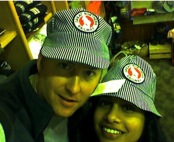
Two members of the Mainlies, guitarist Alexander Lane and vocalist Toni Zaman, are currently working in Spokane, Wa., a “city” of wide streets, charming restaurant (no, that was not a typo), and uncommonly inquisitive people. One recent weekend we drove to Glacier National Park and stayed at one of the few inns still open this late in the year. It is called the Isaac Walton Inn, or something like that, and it is located along a particularly scenic stretch of railroad. Hence, its core clientele in the off season are “rail fans.” If you don’t know what a rail fan is, google it, it’s fascinating. We donned these hats in the gift shop, and were rail fans for the moment. Then we took them off and high-tailed it the hell out of there.
 RSS
RSS
 MainlyBlog